
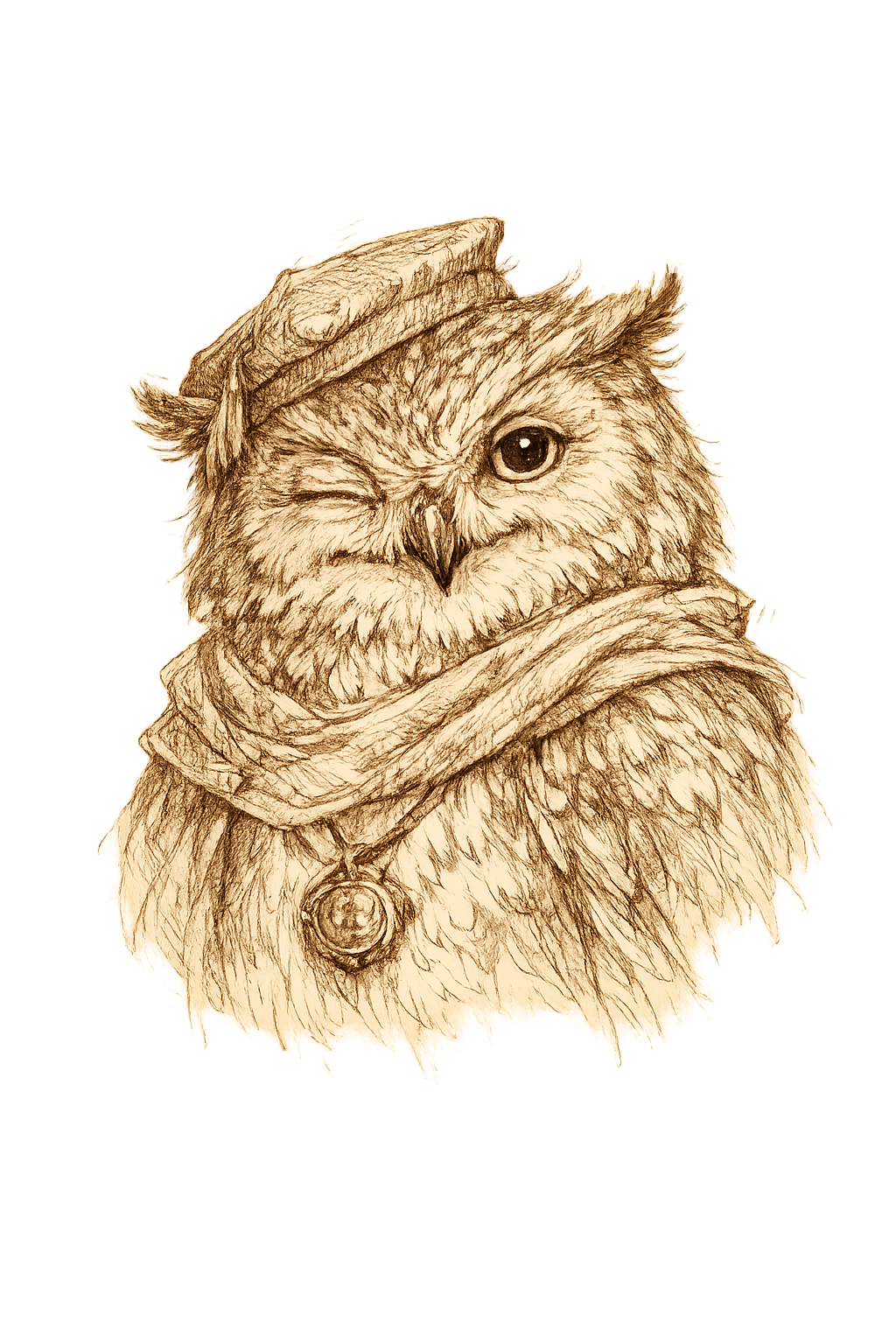
A man who could solve everyone's problems—but one day ended up at the wrong doctor's office.
By Ovi Catanescu
The Owl Doesn't Forget.
My father-in-law, Mișulache, as I used to call him, was an imposing man. A large man, extremely serious, polite, and with a sense of responsibility rarely encountered.
Actually, what people called him depended very much on who was speaking.
His wife, Simona, called him “Mișu” or “The Baron.”
His mother and the rest of his family called him “Mihăiță.”
At work, he was “Mr. Constantinescu,” respected by everyone who worked with him.
The company director, on the other hand, affectionately called him “Nea Mișu”—something like “Old Mișu,” a familiar, respectful Romanian expression.
And I called him “Mișulache.”
One man, so many names. And no matter what you called him, if you had a problem, you knew he was the man who could solve it.
I don't remember ever seeing him laugh. Not because he didn't have a sense of humor, but probably because he didn't have much time for such activities.
Mișulache was a busy man.
A very busy man.
He was the chief accountant at major enterprises in Bucharest. In those days, such a position was no small matter. The chief accountant was one of the director's most trusted people—the man who knew where the money came from, where it went, and, most importantly, where it wasn't supposed to go.
He supervised a large department made up mostly of women. Some had university degrees, others did not, depending on their positions and responsibilities.
Mișulache was fair, demanding, sensible, and strict when necessary.
But he also had a very particular way of addressing women. Regardless of their age or position, his favorite expression was:
“Domniță dragă…”
Literally, “My dear young lady…”
Two words spoken with the courtesy of a gentleman from another era.
But his real job—the one for which he received neither a salary nor a vacation—was being the universal problem-solver for the entire family.
And when I say universal, I'm not exaggerating.
His children, his mother, close relatives, distant relatives, and sometimes people who weren't even related to him—all knew that if they had a problem, they could turn to Mișulache.
School? Mișulache.
Housing? Mișulache.
Doctors? Mișulache.
Money, food, paperwork, cemeteries, funerals, anything involving life and, sometimes, death?
Mișulache.
In his family, there was a phrase repeated so often that it had practically become a family motto:
“Mihăiță, only you can save us!”
And Mihăiță saved them.
It didn't matter how complicated the problem was. He would listen, think it over, and find a solution.
I don't know how he managed it, but he did.
I suspect that if someone had told him there was a problem with the Earth's rotation, Mișulache would have asked, very seriously:
“And who do I need to speak to?”
I don't know whether anyone ever stopped to wonder who would save Mihăiță when he had a problem of his own.
Probably nobody.
Because Mihăiță was the one who saved everyone else.
But every now and then, even the man who solved everyone else's problems had a personal problem to deal with.
And when that happened, he handled it himself.
One day, Mișulache had an appointment with his family doctor.
He was a healthy man and an extremely busy one, so visits to the doctor were rare occasions.
He arrived at the medical clinic, checked in at reception, and went upstairs to the floor where he understood his doctor's office was located.
He found a large waiting room, took a seat, and began to wait.
Disciplined, patient, serious.
As always.
After a while, he looked around.
All the patients were women.
Only women.
Not a single man.
Someone else might have started asking questions.
But not Mișulache.
He had spent much of his professional life managing a department full of women. Being the only man in the room was nothing unusual to him.
So he thought nothing of it.
And continued waiting.
Time passed.
Every so often, a nurse came out of the office and called a name.
Women went in.
Women came out.
Other women waited.
Mișulache sat patiently in his chair.
But his name was never called.
Eventually, the patience of the man who was accustomed to solving problems began to wear thin.
He stood up, approached the nurse, and, with his characteristic politeness and seriousness, asked:
“My dear young lady, please tell me, I have an appointment and I've been waiting for a very long time. Why haven't I been called?”
The nurse looked at him.
For a long moment.
A very long moment.
With an expression that Mișulache probably couldn't quite interpret.
Then she replied:
“Sir, this is the gynecology department. I believe you're on the wrong floor.”
...
I don't know what Mișulache said in response.
I don't even know what expression crossed his face at that moment.
But I certainly wish I had been there!
Because I find it almost impossible to imagine how the man who solved everyone's problems, the man who never seemed to lose his composure, reacted to discovering that he had spent all that time waiting to be examined by a gynecologist.
But the story didn't end at the clinic.
When Mișulache got home, he told his wife, Simona, and their daughter, Maria, what had happened.
And unlike the image of the stern man who was always occupied with responsibilities, this time Mișulache was amused.
He told them how patiently he had waited, how he had noticed that everyone around him was a woman, how nobody ever called his name, and how he finally discovered that he had been sitting in the gynecology waiting room.
They laughed until they could hardly breathe.
All three of them.
I wasn't there. And, as I said earlier, I don't remember ever seeing Mișulache laugh.
But Maria was there.
And she remembers.
I'm glad she told me, because now, after all these years, I can see him in a different light.
Not just as the imposing chief accountant who solved everyone's problems, but also as a father and husband who could come home and make his family laugh until they cried.
And yet, when I think about it, there's a perfectly logical explanation for the entire incident.
Mișulache was so accustomed to solving women's problems that even in a gynecologist's waiting room, it never occurred to him that he might be in the wrong place.
“Mihăiță, only you can save us!” everyone used to say.
But on that particular day, at the gynecologist's office, Mihăiță could have used someone to save him!
The Owl Doesn't Forget. And sometimes, it reminds us that even the most serious people have their own stories worth laughing about.