
Or How I Discovered That Doctors Can Prescribe Good Things, Too
By Ovi Catanescu, with memories contributed by my brother, Adi
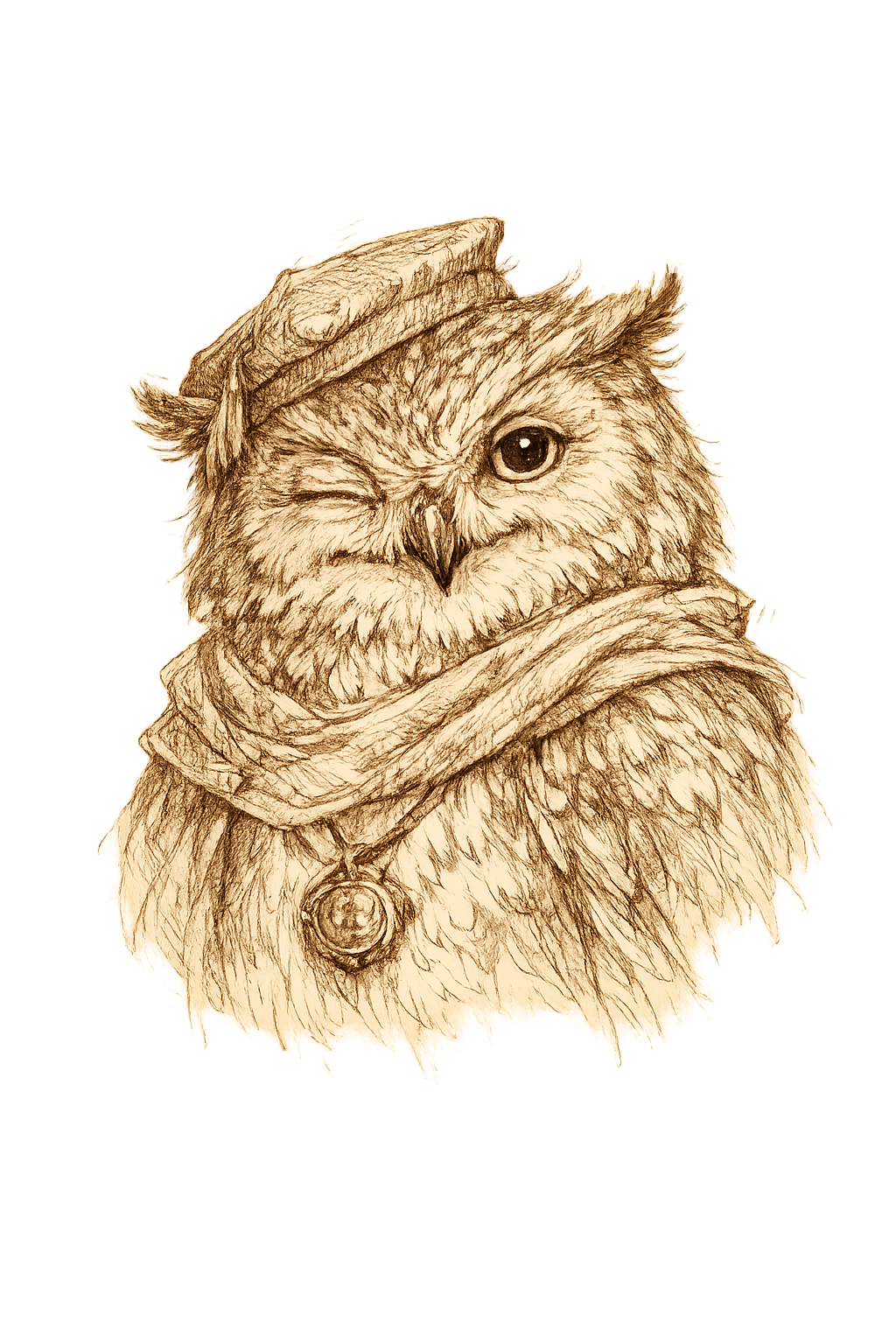
The Owl Doesn't Forget.
I don't remember exactly how old my brother Adi and I were when our parents decided we needed to have our tonsils removed.
What I do know is that we suffered from tonsillitis quite frequently. We were always getting sick with what we simply called "a sore throat," and our mother was becoming increasingly worried.
She had read an expression somewhere that deeply disturbed her, one that Adi still remembers today:
"Streptococcus licks the joints but bites the heart."
For our mother, the thought that something might bite her boys' hearts was simply unbearable.
Besides, doctors in those days tended to regard tonsils as practically useless organs, rather like the appendix—something you could live perfectly well without. At least, that was how our parents understood the medical thinking of the time.
So the decision seemed perfectly logical: remove the troublemakers and save the boys' hearts!
And, probably to avoid making two separate trips, we were both scheduled for surgery on the same day.
The operation would take place at a polyclinic in Brăila, where Fana, a good friend of our mother's, worked as a nurse.
It was the same polyclinic where I would later end up after my bicycle accident involving Colonati, when I suffered a cut between my nose and upper lip.
Naturally, Mom accompanied us.
But before the operation, she had told us something that, at least for me, made the whole adventure much easier to accept:
She had made ice cream for us!
In those days, homemade ice cream was a real treat. We didn't have today's freezers or endless varieties of ice cream. I still remember those little metal trays we used to fill with water to make ice cubes. Mom had used similar trays to prepare our ice cream.
I think it was lemon-flavored because I remember it being slightly yellow.
So I had a very good reason to get through whatever awaited me.
First in Line for the Sacrifice
I couldn't remember which of us had gone into surgery first.
Adi, however, remembers very clearly.
He went first.
According to him, they placed him in a surgical chair, strapped down his arms and legs, and inserted a metal device to hold his mouth open.
They explained that he would feel the needle pricks from the local anesthetic injections, but that afterward everything should proceed without further pain.
Unfortunately, things didn't go quite according to plan.
"It wasn't exactly like that," Adi recalls. "It was very unpleasant. I felt much more than I expected."
Nevertheless, my older brother says he was stoic. He endured the procedure until the end without making too much of a fuss.
Knowing Adi, that doesn't surprise me.
The doctor probably breathed a sigh of relief when she finished with him.
She had no idea what was coming next.
Enter Ovi
I remember several things about my own operation quite clearly.
They placed me in a tall chair, specially designed for procedures like this.
There were two nurses and a surgeon in the room. I couldn't remember whether the surgeon was a man or a woman, but Adi confirmed that she was a female ENT specialist.
According to Fana, she was actually a very good doctor.
I don't know whether Mom came into the operating room with me. Perhaps she stayed with Adi to comfort him after what he had just been through.
But Fana was definitely there.
I remember the nurses holding me firmly in the chair. One of them was certainly holding my head so I couldn't move it.
I also had a vague memory that my arms and legs were strapped to the chair.
Adi confirmed that this was exactly how they had restrained him.
And then there was that metal instrument holding my mouth open.
I couldn't remember whether they had given me any anesthesia.
Adi cleared up that mystery, too: yes, we had received local anesthetic injections.
So, technically speaking, it wasn't really surgery without anesthesia.
But from the perspective of the little boy I was, that distinction didn't mean very much.
As far as I was concerned, the operation had turned into a fight for freedom!
A Less-Than-Cooperative Patient
Adi has his own explanation for my reaction.
He believes that the moment I realized I was strapped to the chair and couldn't move, I experienced something resembling a claustrophobic panic attack.
I don't know whether claustrophobia was really the cause, as he suspects, but I vividly remember struggling against the people trying to hold me still.
From that moment on, according to Adi, everything turned into a nightmare.
It was torture for me and probably just as much for the people trying to complete the operation safely.
I couldn't speak.
I couldn't move.
My mouth was held open by the metal instrument, and blood was collecting at the back of my throat.
And, as Adi remembers it, in my desperate attempts to escape, I was spraying blood all over the doctor's face.
At one point, the poor woman looked, in my brother's words, like a butcher!
I don't know what impression I made on that doctor, but I suspect she didn't forget me anytime soon.
And no matter how friendly Fana was with my mother, at that particular moment I certainly didn't consider her a friend of mine!
Eventually, the operation ended.
The tonsils were gone.
And I was finally free!
"Can't You See, Lady? The Boys Are Vomiting Blood!"
Unfortunately, our adventure wasn't quite over.
When we left the polyclinic, both of us were pale, exhausted, and completely drained of energy.
I remembered vomiting blood right outside the entrance.
Adi remembers that both of us threw up the blood we had swallowed during our operations.
He thinks we were standing near the base of a tree or perhaps a streetlight pole.
He isn't entirely sure.
But he remembers the reactions of the people passing by.
They were horrified.
Two pale little boys, barely able to stand, vomiting blood while their mother stood beside them!
Some of the passersby insisted that Mom take us to a doctor immediately, to the emergency room.
"Can't you see, lady, that these children are vomiting blood?"
Mom probably had to explain that we had just come from the doctor.
I can't imagine how reassuring that explanation must have sounded.
But somehow, we made it home.
The Long-Awaited Treatment
And here my memory takes an interesting leap.
I don't remember the pain after the operation. I don't remember whether swallowing was difficult, whether my throat burned, or how long it took me to recover.
But I remember perfectly how happy I was to be home again.
And, most of all, the ice cream!
That homemade ice cream Mom had prepared in those little metal ice-cube trays stayed in my memory more vividly than many of the details of the surgery itself.
Adi, however, remembers what happened next.
Apparently, we were able to enjoy our ice cream only on the day of the operation and during the night that followed.
After that, the pain became so severe that we could barely swallow our own saliva.
So our delicious treatment was rather short-lived.
And the recovery was probably much more unpleasant than I remember.
Fortunately, we eventually healed.
Later, the ENT doctor assured us that despite all the drama we had been through, the operations had been successful and we could eat whatever we wanted.
And ice cream, especially homemade ice cream, remained one of our favorite treats.
Now we could enjoy it without worrying about getting tonsillitis again.
At least, that was how we saw things back then.
A Sweet Conclusion
Looking back, I'm amazed by the way memory chooses what to preserve.
Adi remembers the injections, the pain, the chair we were strapped into, the blood, the horrified passersby, and the difficult days following the surgery.
I remember mostly the struggle with the nurses, the metal instrument holding my mouth open, and the happiness of finally getting home.
And, of course, Mom's ice cream.
Maybe it really was that delicious.
Maybe I was simply so relieved to have escaped the doctors.
Or perhaps a child's mind has a remarkable ability to preserve, among all the unpleasant memories, the one thing that brought him happiness.
One thing is certain.
After so many unpleasant encounters with medicine, the doctors had finally prescribed a treatment I actually liked!
And if someone had asked me back then what I thought about the operation, I probably would have answered:
"The surgery? I didn't like it very much. It was horrible! But the treatment afterward was absolutely delicious!"
Some childhood memories stay with us because of the pain we experienced. Others because of the fear we felt.
And some, fortunately, because of the taste of ice cream made by our mother.
The Owl Doesn't Forget. But sometimes it needs a little help from the older brother! 🦉